Industrial robots have long repeated fixed motions. AI gives them a way to read changing conditions, choose between learned actions, and adjust their work. The useful question is where that change helps on a factory floor, and where a normal programmed robot still makes more sense.
Quick read
- Cameras can help a robot find parts whose position changes.
- Force sensing can help an arm react when contact differs from the plan.
- AI still needs checks for safety, repeatability, and maintenance.
From fixed paths to changing parts
A programmed robot follows points set by an engineer. That works well when every part reaches the same place in the same direction. The process is easy to check because the robot repeats the same motion each cycle.
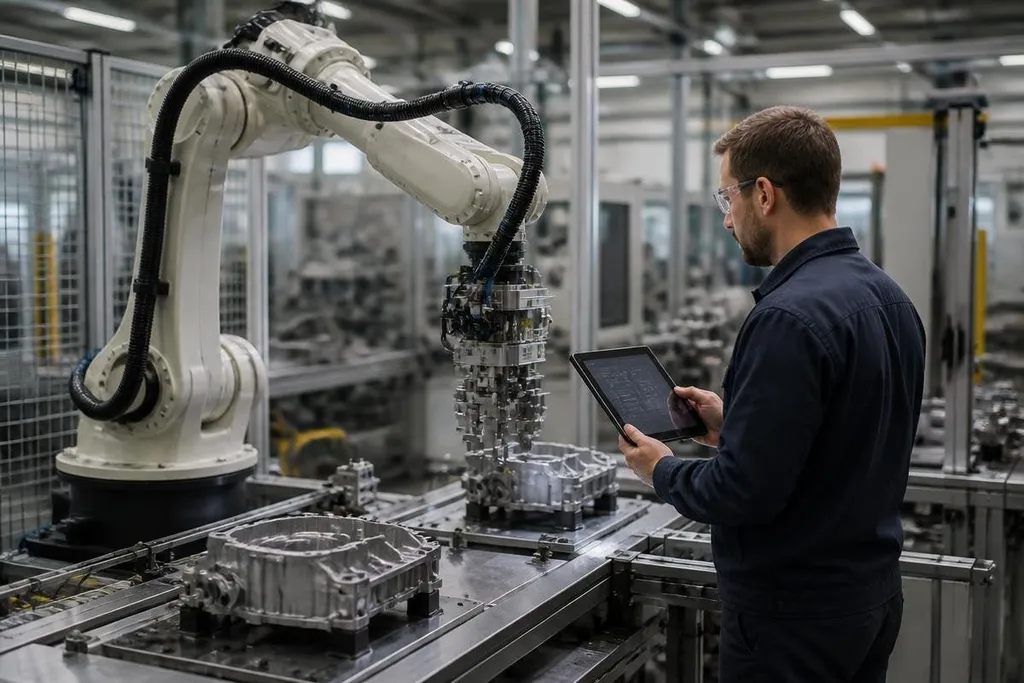
AI changes the input. A camera can send an image to software that identifies a part, estimates its position, and selects a motion. The robot then acts on that result instead of relying on one fixed location.
This matters for work such as sorting, picking, and inspection, where parts may arrive in different positions. The machine still needs a gripper, a motion plan, and limits set by an engineer. AI handles part of the decision; it doesn't remove the need for the rest of the system.
Contact gives the robot more information
Vision can't show every detail. A shiny surface may reflect light, or a part may sit partly under another part. Force sensing gives the robot another signal by measuring contact at the tool or along the arm.
That signal can help an arm detect when a part has touched a fixture. It can also show that a press fit needs more force than expected, or that a gripper hasn't closed around an object correctly. The result is a robot that can react to a physical change instead of continuing along a fixed path.
The limits are clear. A force reading doesn't explain the cause by itself. Software still needs rules for safe force levels, allowed motion, and what happens after a failed grip.
AI can help with faults and maintenance
Industrial robots produce useful operating data through motor current, joint position, temperature, cycle time, and fault messages. AI software can compare new readings with earlier runs and flag a change for a technician to check.
That may help a plant find a worn bearing, a loose part, or a process that is taking longer than planned. The value comes from the follow-up: someone must inspect the robot, confirm the cause, and fix the fault.
A warning is not proof of failure. A changed motor reading may come from a new payload, a different material, or a sensor problem. Any system that sends technicians after false alarms will add work instead of removing it.
A factory team needs to know whether an AI claim comes from a working line, a research setup, or a short demo. Robot24.com's industrial robotics reporting can tie the claim to a named robot, task, site, and date before the next section measures what changes on the floor.
What changes for factory teams
AI shifts some work. Engineers may spend less time writing every robot path.
They spend more time preparing data, checking model results, and setting safe responses. Engineers still define the task, the allowed workspace, and the conditions that stop the robot.
Operators may see fewer manual adjustments when the system can handle small changes in part position. They may also need new checks for bad camera images, incorrect part identification, and software updates.
The strongest case is a task with repeated variation and a clear way to measure success. If every part already arrives in the same place, a fixed program may cost less and be easier to verify.
A practical buying check
Before adding AI to an industrial robot, check these points:
- Name the variation: list the part changes the robot must handle.
- Set the measure: choose a target for cycle time, error rate, or inspection accuracy.
- Check the sensors: confirm that cameras or force sensors can see the needed details.
- Plan failure states: define the stop, retry, and human-check actions.
- Test new data: check how the system reacts to lighting, materials, and worn tools.
- Price the support: include integration, model checks, updates, and technician time.
I'd skip AI for a fixed task unless the plant can point to a real variation that the current program cannot handle.
The next proof to ask for is a measured result on the same task: how often the robot succeeds, how long each cycle takes, and what happens when the sensors are wrong.